The problem with native traffic
Native is the channel where a campaign-level "blocked vs. allowed" number tells you almost nothing. You aren't buying one audience. You're buying clicks from hundreds of publisher sites and widgets at once, and their quality ranges from major news portals to sites that exist mainly to fill widgets.
That creates four problems most cloakers weren't designed for:
Junk is concentrated in placements. Bot clicks, accidental mobile taps and publishers that buy cheap visits to monetize your widget don't spread evenly across a campaign. They cluster in specific site or widget IDs. If your filter only reports totals, you can't tell which placements to cut, and you keep paying for them.
Native creatives are public by design. Your headline sits in a widget on an open publisher page. Native spy databases index those ads and follow the links. A converting advertorial gets copied, sometimes within days.
The funnel is long. A native click rarely lands on the offer. The usual flow is headline, then a long-form advertorial or presell, then the offer page. That means page building, hosting and load time are part of the filtering decision, not a separate job for another tool.
Clicks are cheap and volume is high. You pay for the long tail of placements before you prune it. A tool that adds a redirect hop or a slow third-party page host costs you on every one of those clicks.
How HidePages solves it
HidePages is a page builder with a native traffic filter (Zero-Redirect) for 15+ traffic sources. For native, that means three layers in one account.
1. A filter tuned per page
Each page has its own filter. You decide what it checks:
- Bots and spy tools: automated visitors and known ad-intelligence crawlers.
- Suspicious connections: data-center and hosting ranges, the classic signature of automation on a channel where real readers browse from home broadband and mobile carriers.
- Geo, language and device: catch the placement that's supposed to send mobile US readers but sends desktop traffic geolocated elsewhere.
- Campaign parameters: require the parameters your network always sends, such as the site or widget macro. A click where the macro is missing didn't come through normal ad serving.
Your advertorial for a US mobile campaign and your evergreen presell for a broader GEO can run different rules side by side.
2. Access Logs you can join with placement data
The network tells you where a click came from. The filter tells you what it was. HidePages records every request in the Access Logs with its status and a reason, such as bot_detected, along with IP, country and device.
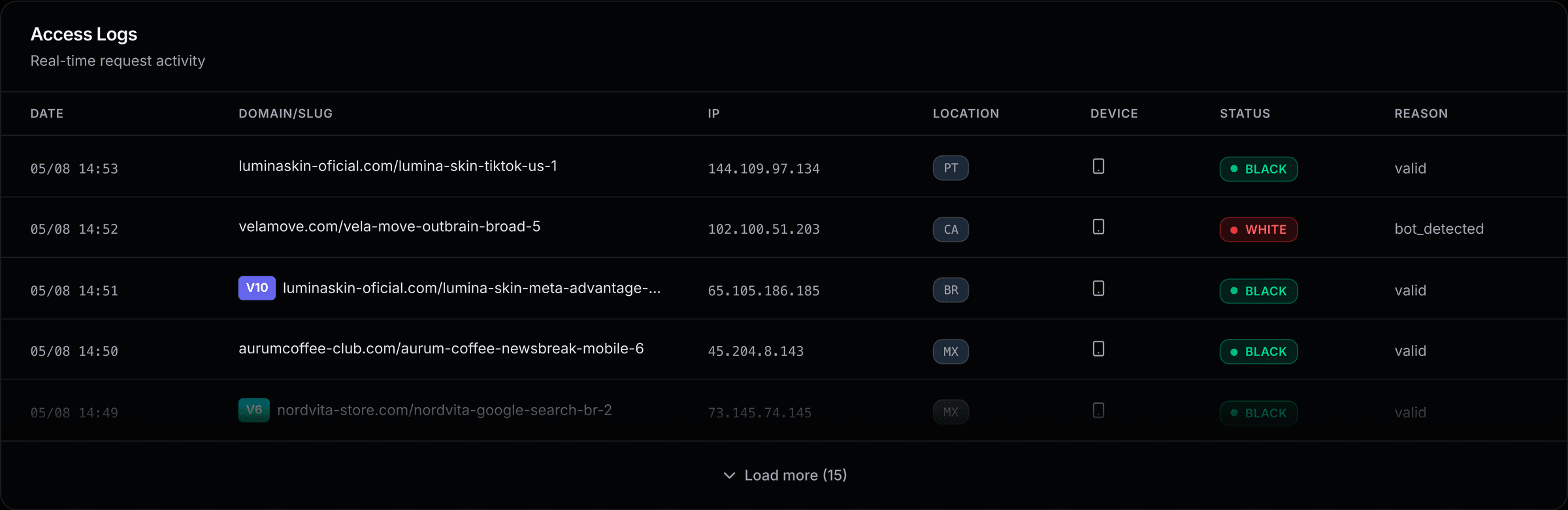
Pass the placement macro into your campaign URL, then compare each placement's filter decisions with its CTR and engagement. Placements that are mostly bots go on the network's exclusion list. Borderline ones get a lower bid. HidePages doesn't sync blocklists to the networks automatically. It gives you the evidence, and you apply it in each network's own tools.
3. Pages built where the filter runs
The advertorial, the presell subpage and the offer page are built and hosted in HidePages. There's no HTML to export, no second host to keep in sync and no integration to install. Because delivery is Zero-Redirect, the campaign link responds directly with the page the rule chose. There's no 302 hop for the network or a spy tool to record, and no extra round trip on a click you already paid for.
Zero-Redirect delivery isn't unique to HidePages. Several tools offer a no-redirect mode, usually running on your own server or PHP. What's harder to find is the combination in one account: no redirect, hosted pages, a native visual builder and per-request logs, with no server and no code.
What you can build for native
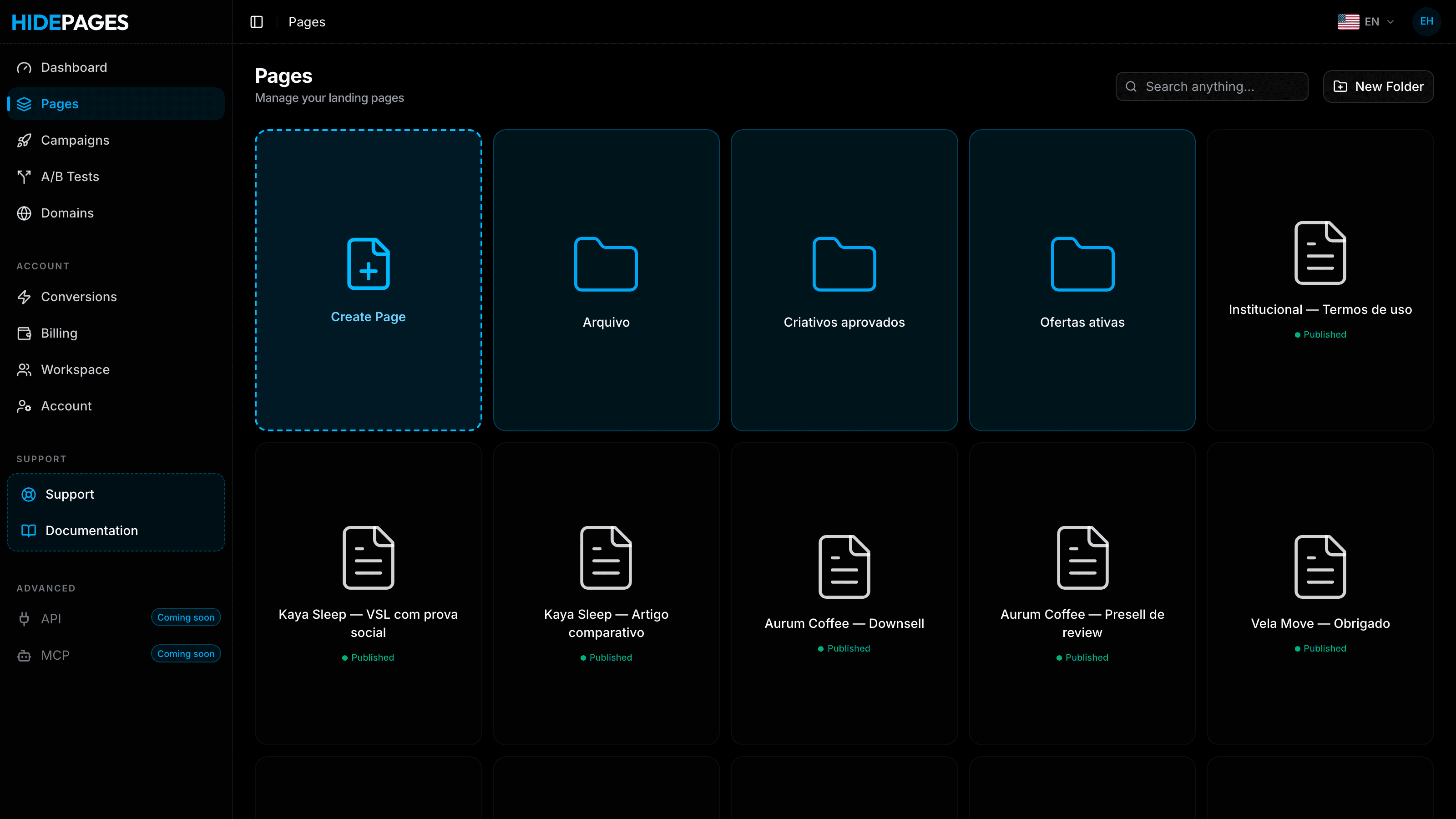
- Advertorials: long-form editorial-style pages that match the headline in the widget. Start from a blank editor, a template, your own code, or clone an existing page by URL.
- Presells: a subpage between the advertorial and the offer, part of the same page tree.
- Quizzes and listicles: common on native for lead gen and nutra.
- White pages: a neutral, compliant page for traffic the filter doesn't send to the offer.
- External offers: Mirror mode serves an external page without a redirect, or use Redirect mode to an external URL when the offer requires it.
- A/B tests and upsell funnels: split advertorial angles and chain offers without another tool.
HidePages vs. the usual native stack
Many native buyers run a tracker, a separate cloaker and a page host or builder. That works, but every handoff is a place where data or speed gets lost.
| Tracker + cloaker + page host | HidePages | |
|---|---|---|
| Where pages live | Separate builder or your own server | ✅ Built and hosted in the same account |
| Delivery | Often a redirect between tools | ✅ Zero-Redirect: link answers with the page |
| Reason per request | Depends on the cloaker | ✅ Status and reason in Access Logs |
| Native networks | Check each vendor's plan | ✅ All six named from Starter |
| Presell subpages, A/B tests | Usually in the builder, separate from the filter | ✅ Same page tree, same filter |
| Setup | Integrations, DNS, scripts | ✅ No server, no code, no integration |
| Deep attribution and postback reports | ✅ A full tracker is strong here | ⚠️ HidePages is not a full tracker |
If you rely on a tracker for attribution, keep it. HidePages handles the filter and the pages, and the placement macro you pass through ties the two together.
Plans
Native sources (Taboola, Outbrain, NewsBreak, MGID, MediaGo, RevContent) are included from Starter at $97/month, which covers 20,000 requests and 30 domains. Growth ($197) raises that to 100,000 requests, and Scale and Enterprise add VIP support with the founding team. The Essential plan covers Meta and TikTok only. No contract; migration from another tool is assisted for free. See all plans on the pricing section.
FAQ
Taboola, Outbrain, NewsBreak, MGID, MediaGo and RevContent are named traffic sources on the Starter, Growth, Scale and Enterprise plans. The same plans also cover Google Ads, YouTube, Meta, TikTok, TrafficJunky and Bigo, among others.
It can filter each request on bots, spy tools, suspicious connections, geo, language, device and campaign parameters, and log a reason for every decision. Blocking a placement at the source still happens inside the network: you use the logs, joined with the placement ID, to build the exclusion list there.
No. Pages are built in the native builder and hosted by HidePages. You can still import your own code, clone a page by URL or serve an external page with Mirror mode.
It removes the redirect hop between the ad click and the page, so there's one less round trip. Final load time still depends on how heavy your page is: images, scripts and fonts matter more than any filter.
Native networks, like other ad platforms, prohibit showing reviewers different content than users see. HidePages doesn't help you get around that, and no tool can guarantee an account won't be blocked. Use it to filter bots and junk placements, protect pages from copying and keep a white page compliant.
Yes. Migration is assisted and free. Talk to the team on Telegram @hidepages and they'll help you move pages and rules.
Keep reading
- Best cloaker for native ads in 2026: 11 tools re-scored for native.
- Bot traffic on native ads: placement macros and the blocklist workflow.
- Protect your landing page from spy tools.
- Migrate to HidePages.
Builder + filter in one layer
Protect your offers before the next spy finds them.
Build your pages, set the filter rules and launch — with Zero-Redirect delivery and every request explained in real-time logs.
- Setup in minutes
- Zero-Redirect
- Free assisted migration